
A tree usually needs trimming or removal before fire season when defects could strike something important. Look for hanging limbs, fresh soil movement, trunk cracks, cavities, mushrooms near the base, or sudden changes in lean. Then look beneath the canopy. A defect over an unused corner carries different consequences than one over a bedroom, driveway, or evacuation route.
A tree risk assessment in Sylmar connects those two sides of the problem. The arborist examines the tree, the site, and everything within reach if a part fails. Structural pruning or deadwooding may reduce the concern while preserving the tree. Root protection, moving a target, or monitoring may also be reasonable. Removal enters the conversation when those measures cannot reduce the risk enough.
Fire clearance adds another question. Dead material and low branches can feed fire without making the whole tree structurally unsound. That is why the inspection comes before the saw.
What Does a Tree Risk Assessment in Sylmar Actually Measure?
An arborist does not label a tree dangerous because it looks old or leans. The assessment considers failure likelihood, impact likelihood, and the consequences of that impact.
The ISA TRAQ program teaches a standardized process for assessing tree risk. Its risk framework weighs failure, impact, and consequences for people, structures, vehicles, utilities, and activities. Without a target, a defect may need care, but the practical risk changes.
Start with the tree. The arborist studies the crown for deadwood, broken hangers, weak unions, and uneven weight. The trunk gets checked for cracks, cavities, decay indicators, wounds, and unusual movement. At ground level, the inspection follows the root flare and surrounding soil.
Fresh cracks or lifted soil can indicate root movement, especially beside a new lean. Construction, paving, trenching, or grade changes may have removed roots or compacted their soil. Those site changes matter because roots provide both water and mechanical support.
Then the arborist studies the target zone. A heavy limb over a parked car presents one problem. The same limb over a play area creates another because people use that space differently.
A Hazard Is Not the Same as Risk
A cavity, split union, or dead branch is a hazard. Risk asks whether that part may fail, strike something, and cause meaningful harm.
That distinction prevents removing a tree for one alarming defect. It also prevents ignoring defects after one uneventful windstorm.
The ISA notes that no tree can be made completely free of risk. Its homeowner guidance recommends professional evaluation when owners notice large dead branches, trunk splits, decay, mushrooms, or recent construction changes.
A proper tree hazard assessment also states its limits. Trees are living structures, and weather cannot be predicted exactly. The finding describes observed conditions during a defined period, then recommends a practical response.
What Does an Arborist See That a Homeowner Might Miss?
Homeowners usually notice the canopy first. Arborists read from crown to trunk, then into the surrounding site.
A sparse canopy may reflect root loss, disease, or seasonal change. Bark loss and mushrooms need context because location changes their meaning.
Two stems may trap bark between them and weaken their union. Long limbs also place leverage on branch attachments.
The soil often tells the quieter story. Retaining walls may cut roots, while parked equipment can compress their soil. A tree safety inspection connects those changes to the canopy above.
Visual evidence may answer the question or support closer inspection. The arborist should explain that difference before recommending removal.
Sylmar’s Hillsides Change the Conversation
Foothill lots around Veterans Memorial Community Regional Park face different exposure than flatter properties farther south. Slope changes vegetation spacing, access, and what sits downhill from a failing tree.
CAL FIRE’s current defensible-space guidance says plant spacing should increase with vegetation size and slope. It also calls for removing dead material and separating shrubs from lower tree branches. Those measures address fuel continuity, not just tree failure.
Los Angeles County’s Defensible Space Inspection Program enforces brush-clearance requirements on improved parcels. A clearance notice may therefore require pruning or vegetation management without proving the tree needs removal.
Protected species add another layer inside Los Angeles. Native oaks, western sycamores, California bay, and Southern California black walnut can require permits. The Los Angeles Fire Department says fire clearance must still follow protected-tree rules.
Do not cut roots or change grade first, then ask questions. Los Angeles treats work that kills a protected tree as removal, even when the trunk remains standing.
From Finding to Recommendation
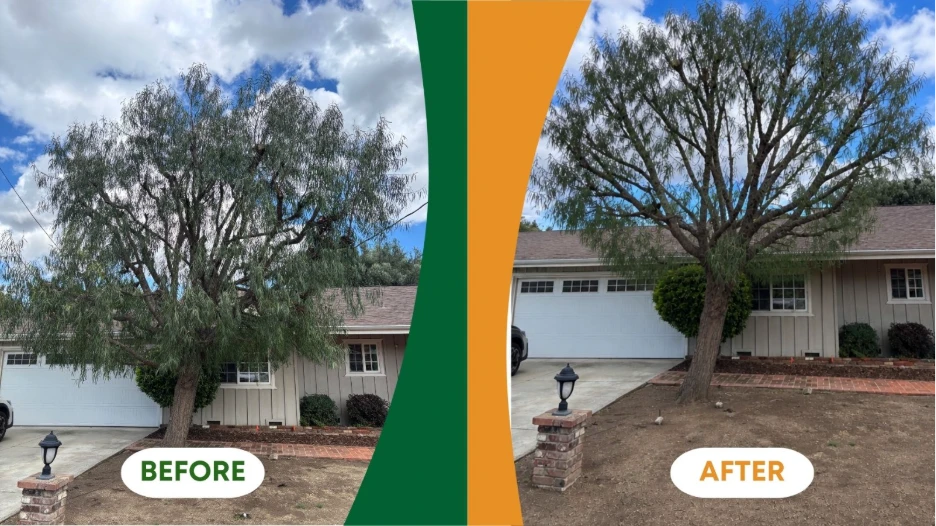
The recommendation should match the part likely to fail. Deadwooding may address isolated dead limbs. Structural pruning can shorten an overextended branch and reduce leverage at its attachment.
Moving a table or vehicle may reduce exposure without cutting. Root-zone protection can prevent further construction damage.
Removal belongs on the table when a major part presents unacceptable risk. The conclusion should identify the defect, target, and alternatives. An arborist report can preserve those findings for an owner, insurer, HOA, or City reviewer.
We handled a coastal oak reported to be over 300 years old. Called Wednesday morning. Done by Friday afternoon. David and Domingo planned around the tree and its surroundings.
When cutting is required, plywood covers planting beds before the first branch drops. Cleanup reaches both sides of the fence line.
Questions Homeowners Usually Ask After the Inspection
Can a tree be dangerous even when every branch has green leaves?
Yes. Green foliage does not rule out root loss, internal decay, or a weak trunk union. A hazardous tree may still produce leaves while its supporting structure declines.
Can moving something beneath the tree lower the risk?
Sometimes. Moving a vehicle, play structure, or seating area can reduce impact likelihood. A house, utility line, or public road cannot be moved, so the tree may need another response.
Does a risk rating stay the same after the inspection?
No. New cracks, construction, fire damage, or major wind can change the condition. Monitoring intervals should reflect the defect, target, and expected changes around the tree.
Should I trim a suspicious branch before the arborist arrives?
Leave it untouched unless an immediate emergency requires action. Fresh cuts can remove evidence needed for the assessment. Keep people and vehicles outside the possible drop zone while arranging the visit.
Put the Right Question in Front of the Tree
Do not start with, “Can this tree come down?” Start with, “What could fail, and what would it reach?” That question separates a pruning job from a removal decision.
Dario Tree Trimming has worked in the San Fernando Valley since 1990. Domingo holds ISA Certified Arborist credential WE-13235A, and our Contractor License is #970593. Show us the trunk, the roots, the canopy, and what sits underneath. A tree risk assessment in Sylmar can identify the defect and the consequence before the next wind tests both. Contact Dario Tree Trimming to arrange the inspection, then decide from evidence instead of waiting for the tree to decide.
