
A tree risk assessment isn’t a glance at the leaves. An arborist works through four questions, in order. What could this tree hit, and how often is someone there? What has changed around it? What do the crown, trunk, and root collar show up close? And finally, how likely is a failure, and how bad would it be? The International Society of Arboriculture builds its basic assessment form around exactly those steps. The answer comes out as a rating from low to extreme, good for a set number of years. Here’s what that looks like when we’re standing in your yard.
It Starts Under the Tree, Not in It
The first thing we look at is what’s underneath. Virginia Tech‘s tree steward course calls a target “the first requirement” for risk. A cracked limb over an empty slope and the same limb over a carport are two different conversations.
Then we measure the reach. A whole-tree failure can land anywhere within one tree height of the trunk. Dead or brittle branches can shatter and fly up to one and a half times that height (ISA). So a 60-foot eucalyptus can reach anything within 60 feet, and debris can go farther.
Last comes how often someone is there. ISA rates occupancy as rare, occasional, frequent, or constant. “Constant” means a target is present nearly 24 hours a day, seven days a week. Your house is a constant target. It never leaves.
Then the Site: What Changed Around This Tree?
An arborist tree inspection reads the yard as closely as the bark. ISA’s form asks about grade changes, site clearing, and changed water patterns. It also asks about saturated soil, limited root space, and pavement or compaction under the canopy.
Wind exposure gets its own line, rated from protected to full, with a box for wind funneling. Here’s why that matters. Say a neighbor took out a row of pines last year. Your tree used to stand in a group. Now it takes the full Santa Ana alone, and nothing about the tree itself has changed.
So expect questions. When was the patio poured? Do the sprinklers hit the trunk? Has anything fallen from this tree before? Your answers often explain what the bark can’t.
Soil matters more than most people think. As of 2011, California’s tree failure database had logged 1,790 root failures, and 57% of the reports that recorded soil conditions noted saturated soil.
How Does an Arborist Inspect the Tree Itself?
A basic assessment means walking all the way around the tree. Alabama Extension lists the usual tools for that level: binoculars, a mallet, and a decay probe. We work from the top down.
The crown. How much is dead, and how thick is the largest dead branch? Are limbs overextended, carrying too much weight at the tips? Are branch attachments weak?
The trunk. Does it split into codominant stems with bark pinched between them? How far around does any cavity reach? Is there ooze, a crack, or a lean, and has the tree grown to correct it?
The root collar. This is where the mallet and probe earn their keep. If the trunk flare is buried, Virginia Tech notes, the roots are short on oxygen. We also look for girdling roots wrapping the trunk, and for a root plate that has lifted.
What California’s Failure Data Says About Coast Live Oaks
Here’s why we spend so long at the base of an oak. Coast live oak is the most commonly reported species in California’s tree failure database. In the 2014 data, 40% of its failures were at the roots, 37% at the trunk, and only 23% at branches.
Decay showed up in roughly three of every four failures, across roots, trunks, and branches. And wind wasn’t the whole story. In 2014, 39% of coast live oak failures happened in winds under 5 mph.
The data points to where the eye should go. Half the branch failures broke at the attachment, right where the limb meets the trunk. Heavy lateral limbs showed up in a third of them. Multiple trunks showed up in about a third of trunk failures.
When a Basic Tree Risk Assessment Isn’t Enough
Sometimes the mallet sounds hollow and the probe can’t answer how hollow. That’s when an advanced, Level 3 assessment comes in. Alabama Extension lists sonic tomography and resistance-recording drills among those tools for finding decay.
Those tests cost more, and they aren’t needed for every tree. A large oak over a bedroom with signs of internal decay might justify one. A small tree over a garden bed rarely does. We’ll tell you straight which side of that line your tree falls on.
What a Hazardous Tree Assessment Actually Hands You
The end result is a rating, not a gut feeling. ISA rates the likelihood of failure as improbable, possible, probable, or imminent. That gets combined with the likelihood of hitting the target, then with the consequences. The final risk rating lands on low, moderate, high, or extreme.
Every rating comes with a time frame, usually one to five years on ISA’s form. A tree rated low today isn’t rated low forever. Then come the options, with the highest risk listed first.
One honest line belongs in every report: residual risk. ISA allows “none” only when the tree comes out completely. Virginia Tech says the same: risk “is never completely eliminated unless the tree is removed.” Every other choice lowers it, and you decide what’s acceptable.
A Santa Clarita customer’s review described the visit with Dario Tree Trimming well: an estimate, plus a professional opinion on what the trees needed. When the answer is pruning, the work looks like this. Plywood goes over the plants before the first cut. Then the crew cleans the neighbor’s side too, as one landscape contractor noted in a review.
Frequently Asked Questions
Will a tree risk assessment always end in removal? No. Virginia Tech’s course lists moving the target, pruning, support systems, and removal as options. Removal is one choice among several.
How often should a tree be reassessed? Every rating has a time frame, typically one to five years. Reassess sooner after a hard pruning, or a major windstorm.
Is a hazardous tree assessment the same as an arborist report? The assessment is the inspection and the rating. A written report documents it, for your records, your insurer, or your HOA.
Which Target Would You Move?
Most homeowners never consider this. Risk drops when the tree changes, but it also drops when the target does.
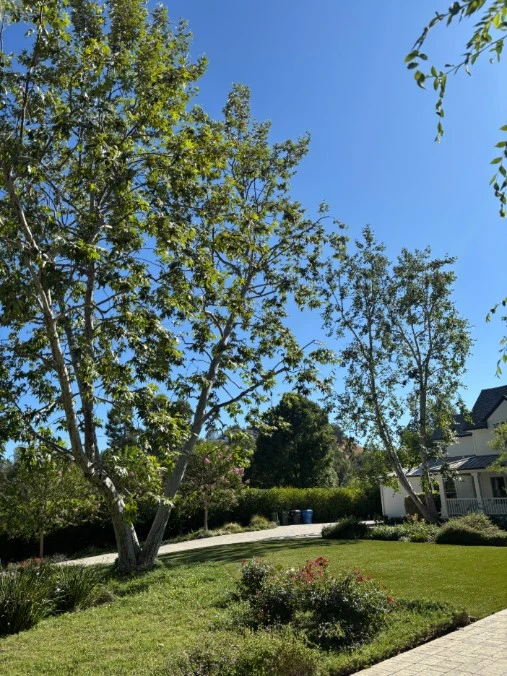
Think about your largest tree, and what sits within one tree height of it. The car parked under it every night. The trampoline. The home office window. Moving one of those changes the math without touching the tree.
Before you move the car or the trampoline, find out whether you need to. Reach out today and we will rate the tree and everything within its reach, then tell you which change lowers the risk most.
