
Buying in Sylmar, Northridge, Encino, or Sherman Oaks often means buying a mature tree or three along with the house. Your home inspector looks at them, but only one way. The standard many inspectors follow covers vegetation “likely to adversely affect the building” (ASHI). It doesn’t ask whether the eucalyptus by the back fence is healthy, or what it will cost to keep. An arborist report in San Fernando Valley escrow answers that. California’s standard purchase contract gives you a window to get it. Here’s how to use that window, and what Valley buyers in particular should know before they sign.
What the Home Inspection Covers, and What It Doesn’t
This isn’t a knock on home inspectors. Their standard is built around the house. ASHI’s version tells inspectors to look at vegetation, grading, and drainage likely to affect the building. It also excludes geological, geotechnical, and hydrological conditions.
So a tree gets attention when it threatens the roof, the foundation, or the drainage. A big pine at the back may get one line in the report, or none. Nobody is asking how much life it has left, whether it’s carrying decay, or what it will need in the next five years.
Those are arborist questions. And on a Valley lot with mature trees, they can carry real money.
When to Book an Arborist Report in San Fernando Valley Escrow
California’s standard purchase contract, the C.A.R. Residential Purchase Agreement, gives the buyer 17 days by default to investigate the property, at the buyer’s expense (C.A.R.). The buyer and seller can agree in writing to a longer or shorter window, and the seller has to make the property available.
That window fills up. General inspection, termite, sewer line, insurance quotes. So book the tree inspection in the first week, not the last. A written report that arrives on day 16 doesn’t leave much room to use it.
What a Pre-Purchase Arborist Report Tells You
A good pre-purchase report reads like a budget, not a biology lesson. For each significant tree, it covers:
- What it is. Species, size, and where it stands relative to the house, the pool, and the neighbors.
- What shape it’s in. Health, structure, and any defects that matter for safety.
- What it needs. Pruning, deadwood removal, cabling, or removal, and roughly when.
- What that will cost. A written estimate from the crew that would actually do the work.
- What to watch. Problems that aren’t urgent yet but will be in a few years.
That last line is the one buyers tend to miss. A tree that’s fine today but due for major work in three years is still a cost. It’s just a cost the seller won’t be around for.
What’s Different About Buying in the Valley
The fire map moved. CAL FIRE’s 2025 maps pushed “very high” fire hazard severity north of Ventura Boulevard in some parts of the San Fernando Valley (LAist). The Valley has seen why. In October 2019, the Saddleridge Fire started in Sylmar and jumped the 5 into Granada Hills and Porter Ranch (ABC7).
That map matters at sale. Since July 1, 2021, sellers in High or Very High Fire Hazard Severity Zones must give the buyer documentation of defensible space compliance (Civil Code 1102.19). If the paperwork isn’t ready before closing, the buyer and seller must sign a written agreement that puts it on the buyer to obtain within a year (CAL FIRE). That can make the tree trimming your job. So check the address on CAL FIRE’s map before escrow starts, and not just in the foothills.
Most of the Valley follows one city’s tree rules, but not all of it. Sylmar, Granada Hills, Northridge, Van Nuys, Encino, and Sherman Oaks sit inside the City of Los Angeles. There, native oaks, black walnut, western sycamore, and California bay are protected once the trunk reaches 4 inches across, measured combined at chest height (StreetsLA). Two native shrubs, toyon and Mexican elderberry, are protected too. The City’s guide calls coast live oak the most common oak in Los Angeles, found from the Pacific Palisades to the San Fernando Valley. Burbank and San Fernando are separate cities with their own rules. Either way, if you’re picturing the yard without that oak, know first whether it’s protected.
Turning the Report Into a Negotiation
The purchase agreement spells out your options during the investigation period. You can approve the property’s condition, or use a Request for Repair to ask the seller to fix items, lower the price, or give you a credit (C.A.R.). If the seller won’t, you either move forward or cancel.
A tree report makes that request specific. “The trees look old” goes nowhere. “The pine over the garage needs deadwood removal, and here’s the estimate” gives the seller something to answer. A seller can still say no. But a priced, written item is easier to negotiate than a worry.
How We Handle a Pre-Purchase Visit
Speed matters inside escrow. One Northridge customer with a coast oak said to be over 300 years old wrote: “I called Wednesday morning. The job was done by Friday afternoon”. That’s the pace a 17-day window needs.
Here’s what you get back after the visit: a written report signed by an ISA certified arborist. Ask to include the price next to every recommendation. Forward it to your agent the day it arrives. Because those prices come from the crew that would climb the trees, your repair request rests on real numbers instead of a ballpark. And if the deal falls apart, you still walk away knowing exactly what that lot would have cost you.
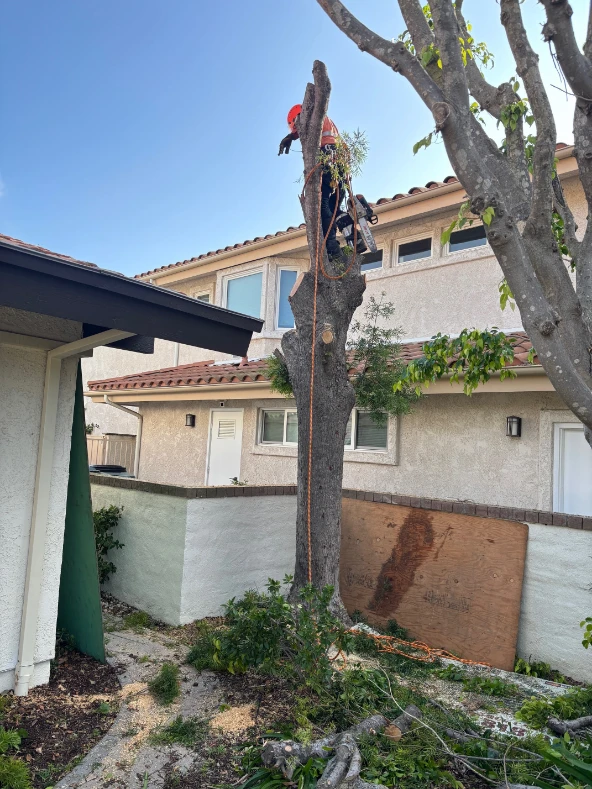
And if you buy the house, the work goes the way it always does. Plywood over the beds first. Then the trimming, branch by branch. And before the truck leaves, both sides of the fence line get swept, including your new neighbor’s.
Frequently Asked Questions
Isn’t the home inspection enough? For the house, yes. For the trees, it usually covers only what threatens the building. Health, structure, and future cost are arborist questions.
When during escrow should I book the tree inspection? As early as you can. The standard investigation period is generally 17 days, and the report needs time to inform any repair request.
Can I ask the seller to pay for tree work? You can request repairs or other actions during the investigation period. The seller can agree, counter, or decline, so a specific, written estimate helps.
How do I know if a Valley home is in a fire hazard zone? Look up the address on CAL FIRE’s fire hazard severity zone map. The 2025 maps extended “very high” north of Ventura Boulevard in parts of the Valley, so don’t assume a flat street is outside it.
Before You Sign, Count the Trees
There’s one stretch of time when the seller still has a reason to talk about the trees: the days before you remove contingencies. After that, every dead limb and overdue trim belongs to you, and so does the bill.
So try this today. Pick the tallest tree on the lot and ask the listing agent when it was last pruned, and by whom. If nobody knows, you’ve learned something important about the trees you’re about to own.
A tree inspection before buying a home only helps if it arrives in time. Call Dario Tree Trimming with two things ready: the property address and your contingency deadline. We’ll schedule the visit early in your window, so the written report can arrive before your repair request is due.
